

CHIPS: Rethinking How We Classify Food

What is CHIPS?

CHIPS (Combining Health, Intuition, Processing and Science) is a food classification framework designed to evaluate diet quality based on food processing, health evidence, and real-world practicality.
It evolved from our earlier framework, the Human Interference Scoring System (HISS), which assessed how far foods had been altered from their natural state. Through further research, critique of existing systems, and user feedback, the framework was refined and expanded into CHIPS.
CHIPS was developed to address limitations of widely used food classification systems such as NOVA, particularly inconsistencies in classification and limited integration of health evidence.
The framework groups foods into three intuitive categories:
- Whole and minimally processed foods
- Processed foods
- Ultra-processed and junk foods
The goal is simple: to provide a clear, practical way to assess diet quality and support healthier food choices.
From Framework to App
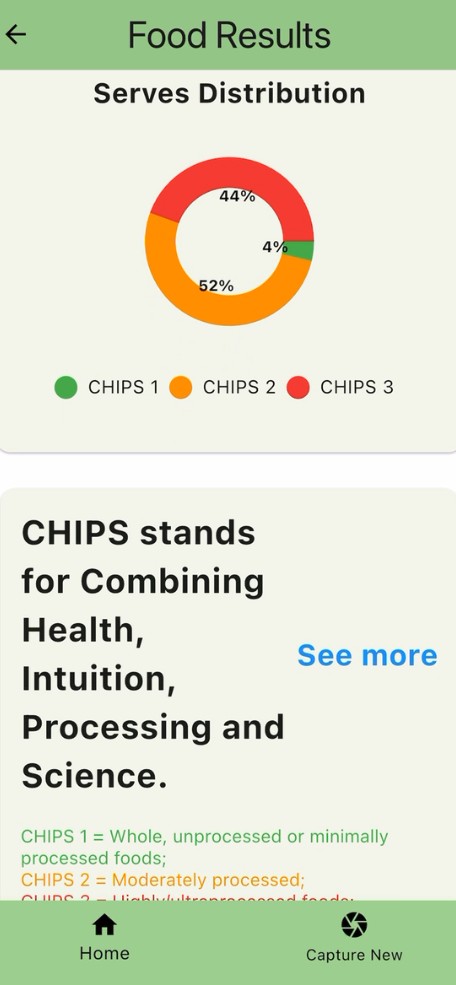
The original HISS framework formed the basis of the HISS App, an AI-powered mobile tool that classifies foods from photos.
The app helps users:
- See how much of their diet comes from different food categories
- Reflect on eating habits
- Shift towards more whole and minimally processed foods
The app is currently being updated to incorporate the refined CHIPS framework.


Pilot Study
Development of the app was supported by a Health Research Council (HRC) Activation Grant.
A pilot study tested the tool’s accuracy, usability, and cultural relevance with:
- Adolescents (12–18 years)
- Tertiary students (19–25 years)
- Māori and Pacific health coaches
Key findings included:
- 93% agreement with researcher food classification
- Strong usability and cultural relevance
- Increased awareness of diet quality and food choices
Several scientific papers from this work are currently under peer review.
Current and Future Research
We are refining the CHIPS framework and exploring how it can support healthier diets across different populations.
Current research includes:
- Metabolic health: improving diet quality in prediabetes, type 2 diabetes, and metabolic syndrome
- Healthy ageing: supporting adequate protein intake and reducing sarcopenia risk
- Culturally responsive nutrition: developing tools tailored for diverse communities in New Zealand
- Adolescent wellbeing: encouraging healthier dietary patterns
- Ultra-processed foods: examining nutrient quality in diets high vs low in UPF
- Vegan diets: reducing ultra-processed foods while maintaining nutrient adequacy
- Ménière’s disease: quantifying dietary patterns to explore potential symptom links